


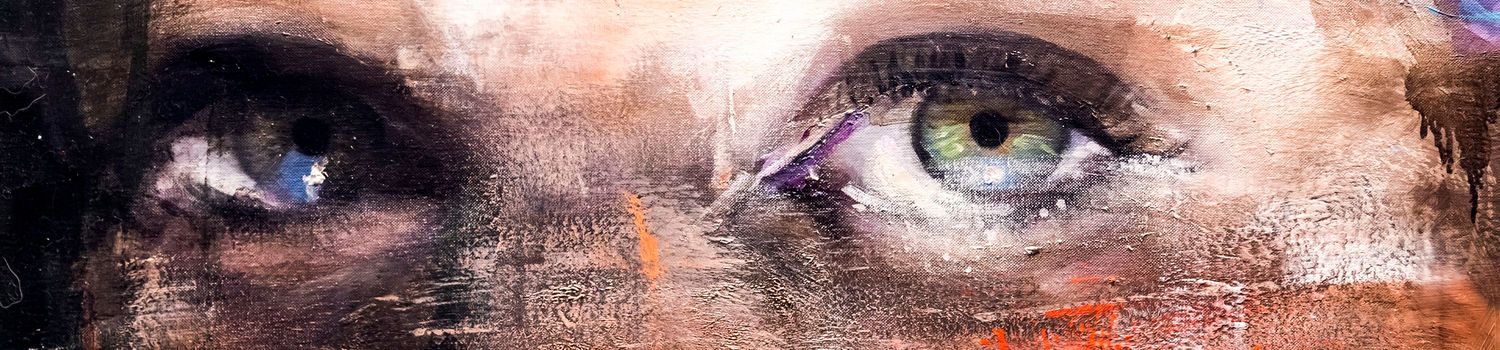
When does looking become an aesthetic experience?
Author: Ruud van der Splinter / Dutch Luxury Design
April 2026
Why this Practice Insight?
Within contemporary creative practice, much is said about form, material, technique, concept and craftsmanship. These are indispensable aspects of the making process. Yet they do not fully explain why some works leave us untouched, while others invite us to look longer and discover something new each time we return to them. This Practice Insight explores that experience. Not to provide a definitive answer, but to better understand what happens when looking becomes an aesthetic experience. What makes an object become more than something we simply look at? And what does that mean for the development of the contemporary creative practice?
The Encounter
The museum gallery is quiet. Soft daylight enters the room and spreads evenly across the space. Along the walls hang works that do not demand attention. On a number of plinths stand objects that seem to ask nothing of the visitor. As people walk through the gallery, their gaze moves naturally from one work to another. Some objects barely register. Others hold their attention for a little longer. The rhythm remains unchanged. Until one work slows their pace. Not because it is larger. Not because it appears more spectacular. Quite the opposite. Its presence is remarkably restrained.
At first glance, very little seems to happen. But as the viewer takes a step to one side, the light changes. A shadow shifts. A reflection appears. A detail that had barely been visible begins to emerge.
The object itself has not changed. Yet the encounter has.
There is no sudden revelation, nor an immediate explanation. Something else begins to take shape: the desire to look again.
The second glance is different from the first. Not because the object has offered new information, but because the viewer's attention has changed. Looking slows down. What initially seemed straightforward reveals unexpected depth and complexity. It is precisely in that moment that a question arises—one that many makers will recognise.
When does looking become an aesthetic experience?
The Practice Question
When we speak about the quality of art or design, we often describe the qualities of the object itself. We talk about composition, materiality, originality, technical mastery or expressive power. These are important concepts, yet they primarily describe the work itself. They do not fully explain the experience of the viewer. Why do we walk past one object while another invites us to stop? Why do some works continue to unfold over time, while others seem to reveal everything at first glance?
Perhaps the aesthetic experience does not reside solely within the object. Perhaps it emerges in the encounter between the object and the person who is looking. This perspective shifts our attention away from the properties of the object towards the way an encounter develops. The object itself is no longer the only point of focus. Equally important is the relationship that unfolds between the work and its viewer. To better understand this phenomenon, we turn to several thinkers who have written about perception, experience and wonder.
The Inquiry
A natural starting point is the American philosopher John Dewey.¹ In Art as Experience, Dewey challenges the idea that art should be understood as an autonomous object. According to him, a work of art acquires meaning only through the experience that arises when someone actively engages with it.
Attention therefore shifts from the object to the encounter. For Dewey, an aesthetic experience is not a collection of isolated impressions but a coherent process. Our attention is not forced; it gradually deepens. We do not simply look in order to recognise or evaluate something. We are invited to remain with the work.
This helps explain why certain objects do not reveal themselves immediately. They do not ask for more information. They ask for a different quality of attention.
Yet this raises another question. How does that attention arise? The French philosopher Maurice Merleau-Ponty offers an important perspective.² He argues that perception is not the passive registration of an objective reality. We perceive the world because we are physically part of it. Every change in position, light, distance or movement alters what becomes visible. An object therefore never exists as a single, definitive image. As we move around it, we do not encounter a series of identical views. Light, shadow, reflection and perspective continuously change. The object remains the same, but the encounter keeps developing.
Perception, then, is not a frozen moment. It is a process.
The Finnish architect and theorist Juhani Pallasmaa extends this idea by arguing that our experience of art and design is never purely visual.³ We perceive an object with our entire body. Material, texture, scale, light and space together create a sensory experience in which seeing, moving and feeling are inseparable. The encounter with an object therefore has a physical dimension that cannot be reduced to vision alone. Perhaps this explains why some works cannot be understood at a single glance. They invite us to return. To look again. And to discover new relationships.
Yet even this does not fully explain the nature of the aesthetic experience. Attentive looking alone is not enough. We can study a technical drawing, an everyday object or a road map with great concentration without experiencing anything we would call aesthetic.
Something else seems to happen.
Sometimes, while looking, there is a moment when an object is no longer simply perceived but genuinely encountered. Such a moment cannot be forced. It emerges when a work does not fully reveal itself at first glance. Not because it is complicated, but because it unfolds gradually. Every shift in position, every subtle change in light and every renewed act of looking reveals another aspect of the work. Perhaps this is the experience we call wonder.
As early as Aristotle, wonder was understood as the beginning of inquiry.⁴ Wonder is more than surprise. It arises when something that once seemed self-evident suddenly no longer is. It opens a space in which no immediate answer exists, but where a question begins to emerge—a question that invites further exploration. Contemporary psychological research on awe describes a remarkably similar phenomenon. Dacher Keltner argues that experiences of wonder temporarily disrupt our existing frameworks of understanding.⁵ Rather than immediately explaining or judging what we encounter, we are invited to expand our understanding of reality itself. Wonder is therefore not simply an emotion. It is an experience that deepens attention and creates space for new meaning to emerge.
The anthropologist Ellen Dissanayake places this experience within a broader human context. According to her, the desire to experience something as special or meaningful is a fundamental human characteristic.⁶ Art derives its significance not only from the object itself, but also from its capacity to focus our attention, deepen perception and invite us to see the world with renewed awareness.
When we return to the museum gallery where this Practice Insight began, we find exactly the same space. The objects have not changed. The daylight still enters through the same windows. Yet the encounter has become different. Not because we know more about the object. But because we understand more clearly what unfolds while we are looking.
The aesthetic experience arises neither solely within the object nor solely within the viewer. It emerges in the encounter between the two.
This insight has important implications for the way we think about the contemporary creative practice. When a maker develops an object, they are not only developing form, material, technique or composition. They are also shaping the conditions under which an encounter may take place. Not in order to determine the viewer's experience, but to create space in which attention, wonder and meaning can unfold.
Design, then, acquires a broader significance. It is not only concerned with what becomes visible. It is equally concerned with how something becomes visible.
Practice Insight
The inquiry shows that an aesthetic experience cannot be fully explained by the object alone, nor by the viewer alone. It emerges in the encounter between the two.
From the perspective of the contemporary creative practice, we would like to add a Practice Insight to this understanding. When a maker develops their practice, they are not only developing objects. They are also exploring the kinds of encounters their work makes possible. This shifts the way we think about creative practice. The development of a practice is not only about refining form, material, technique or concept. It is equally about developing a deeper understanding of how one's work relates to the people who encounter it.
This does not mean that a maker can design another person's experience. Every encounter remains shaped by the individual, the context and the moment in which it takes place. What makers can do, however, is investigate which qualities of their work invite sustained attention, which decisions slow down perception, and which spatial, material or sensory qualities deepen the encounter. This, in turn, shifts one of the fundamental questions within the contemporary creative practice.
Not only: "What do I want to make?"
Or: "What do I want to express?"
But also: "What kind of encounter does my work make possible?"
Perhaps this is one of the defining characteristics of the contemporary creative practice. Ultimately, it is not the object itself that becomes the primary subject of development. Rather, it is the ongoing exploration of the quality of the encounter that the object enables. That, we believe, lies at the heart of creative practice.
References
1. Dewey, J. (1934). Art as Experience. New York: Perigee Books.
2. Merleau-Ponty, M. (1945/2012). Phenomenology of Perception. Routledge.
3. Pallasmaa, J. (2012). The Eyes of the Skin: Architecture and the Senses. Wiley.
4. Aristotle. Metaphysics, Book I.
5. Keltner, D., & Haidt, J. (2003). Approaching Awe: A Moral, Spiritual, and Aesthetic Emotion. Cognition and Emotion, 17(2), 297–314.
6. Dissanayake, E. (2000). Art and Intimacy: How the Arts Began. University of Washington Press.